
Engineering Reference

Inside the pump.

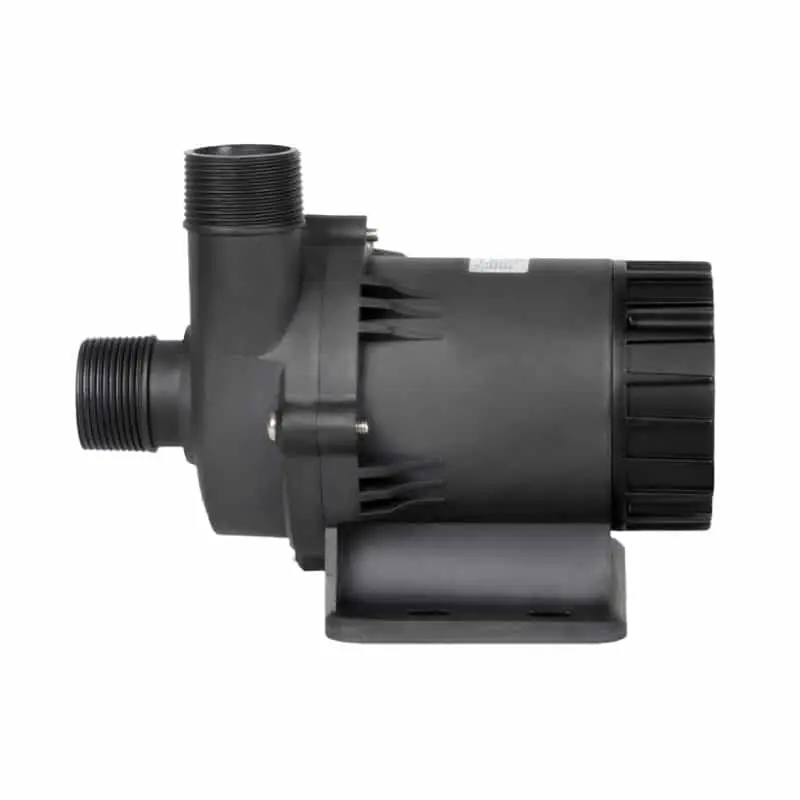
A technical breakdown of every critical component inside an industrial mag-drive circulation pump — what it does, how it fails in commodity units, and how AquaForge addresses each failure mode.

Components

Every system, fully specified.

/ 01

Magnetic Drive Coupling

A sealless mag-drive pump replaces the traditional shaft seal with two coaxial magnet assemblies separated by a containment shell. There is no rotating shaft penetrating the wet end — which means no mechanical seal to wear, no seal water to monitor, and no leak path to the motor. The result is a pump that runs for years in chemistry that would destroy a sealed pump in months.

/ 02

Impeller & Wet End

The AF-Pump 85 wet end uses a corrosion-resistant engineered polymer impeller and volute, rated for continuous-duty operation in fresh and saltwater loops. Hydraulic geometry is tuned for high flow at low to moderate head — exactly the duty point industrial chillers, large aquariums, and cold plunge systems demand.

/ 03

Ceramic Shaft & Bushings

A pure ceramic shaft riding in ceramic-or-graphite bushings is the only contact point inside the wet end. Ceramic-on-ceramic tolerates particulate-laden water far better than steel-on-bronze, runs cooler, and has no metallic ions to leach into a sensitive process loop.

/ 04

Motor Windings & Encapsulation

The motor stator is fully encapsulated in epoxy resin and isolated from the process fluid by the containment shell. There is no path for water to reach the windings — even if the wet end is flooded. Motor failures from seal leaks, the single most common failure mode in conventional circulation pumps, are designed out.

/ 05

Variable Speed Controller

An integrated VSD lets the operator dial flow to the exact duty point, rather than throttling a fixed-speed pump with a valve. Lower RPM means lower power draw, lower noise, longer bearing life, and the ability to ramp to demand instead of running flat-out 24/7.

/ 06

Common Failure Points

On commodity mag-drive pumps: shaft fracture from particulate ingestion, bushing wear from running dry, magnet decoupling from cavitation, and controller failures from poor thermal management. AquaForge addresses each through pre-filtration guidance, dry-run protection on the controller, NPSH-correct sizing, and a vented controller housing.

/ 07

Maintenance Requirements

Simple and minimal maintenance required for long-lasting usage. Every AquaForge ships with a documented maintenance schedule and service manual.